Heard of a building called Antilia being built in Mumbai with six floors of parking, mini theatre, two floors for terrace gardens, a floor with swimming pool and health club, four floors of apartments and three helipads and all that for a single family?
Yeah thats true. Who else but MK could do that. Read here.
Thursday, June 28, 2007


Friday, June 22, 2007
2nd GR (part 2)
In my previous post on GR, some wondered whether the entry of corporates will really better farmers lives and benefit the consumers as well.
Heres what Gurcharan Das says about it in his blog.
The price of potatoes, November 19, 2006
I sometimes wonder why I pay Rs 10 per kilo for potatoes when the farmer receives only Rs 3. My potatoes travel some distance, I realise, from the farm to the mandi to my bania, and each person in the chain must get his cut. Still, the gap of Rs 7 seems excessive, especially when the American farmer receives Rs 4 to 5. This gap varies, of course, depending on the commodity and the season, but studies by agricultural economists show that farmers in the developed countries do get a bigger share of the consumer price because their distribution chain is shorter.
Reliance opened seven supermarkets in Hyderabad last month and my friend bought potatoes there for Rs 10 per kilo compared to Rs 18 at his bania’s shop. Another friend who works with an NGO in rural Andhra reported that farmers, who had supplied potatoes to Reliance, reported receiving higher than the mandi price. How could Reliance pay a higher price to farmers and charge a lower price to consumers? Simple--it had eliminated middlemen in the chain. Thus, we should welcome the entry of large retailers. They will bring logistics efficiencies and competition between them will lower consumer prices and raise farmers’ incomes. We shouldn’t wait too long to open this sector to foreign retailers like Walmart and Tesco lest Reliance become a monopoly.
A typical farmer harvests his crop, loads it on his bullock cart, travels30 km to the mandi, where he is forced to sell often at distress prices. Once at the mandi, he cannot return without disposing his produce. He needs the money and the trader knows it. Had he known the price before he left, he might have waited a few days. Where E chaupals have arrived farmers are happy because they get to know mandi prices via the Internet. The national commodities exchange (NCDEX) is setting up electronic tickers announcing spot and future prices in local languages at mandis and bus stands in some states. Eventually, the mobile phone will be the farmer’s best source of information. All these developments make traders unhappy.
Since his crop is perishable, the farmer needs a warehouse to enhance his staying power. NCDEX is putting up a thousand cold storages with world class grading facilities, but large retailers will also bring air-conditioned warehouses and trucks, and this will save India’s huge post harvest losses, as high as 40% for some crops. Banks ought to lend money to farmers against warehouse receipts, but the Reserve Bank refuses to allow them to hedge against future prices. This is a pity for bank loans would mitigate the farmer’s risk and improve his holding power. In fact, banks should also sell crop insurance. It is amazing that RBI should view futures trading as speculation. If the farmer knows the price of potatoes, he might plant onions instead.
Old habits of the mind die slowly. When you have been a stagnant, peasant agriculture for hundreds of years, it is difficult to grasp how Reliance, commodity exchanges, futures trading, and contract farming will quietly bring a second green revolution and liberate farmers from the clutches of the old mandi system, which is at the heart of rural political patronage. Activists oppose the entry of global retailers like Walmart on ideological grounds. Talk of farmer suicides is cheap. Politician-traders on Agricultural Marketing Committees play on these insecurities. No wonder it takes so long to reform in a democracy.
Heres what Gurcharan Das says about it in his blog.
The price of potatoes, November 19, 2006
I sometimes wonder why I pay Rs 10 per kilo for potatoes when the farmer receives only Rs 3. My potatoes travel some distance, I realise, from the farm to the mandi to my bania, and each person in the chain must get his cut. Still, the gap of Rs 7 seems excessive, especially when the American farmer receives Rs 4 to 5. This gap varies, of course, depending on the commodity and the season, but studies by agricultural economists show that farmers in the developed countries do get a bigger share of the consumer price because their distribution chain is shorter.
Reliance opened seven supermarkets in Hyderabad last month and my friend bought potatoes there for Rs 10 per kilo compared to Rs 18 at his bania’s shop. Another friend who works with an NGO in rural Andhra reported that farmers, who had supplied potatoes to Reliance, reported receiving higher than the mandi price. How could Reliance pay a higher price to farmers and charge a lower price to consumers? Simple--it had eliminated middlemen in the chain. Thus, we should welcome the entry of large retailers. They will bring logistics efficiencies and competition between them will lower consumer prices and raise farmers’ incomes. We shouldn’t wait too long to open this sector to foreign retailers like Walmart and Tesco lest Reliance become a monopoly.
A typical farmer harvests his crop, loads it on his bullock cart, travels30 km to the mandi, where he is forced to sell often at distress prices. Once at the mandi, he cannot return without disposing his produce. He needs the money and the trader knows it. Had he known the price before he left, he might have waited a few days. Where E chaupals have arrived farmers are happy because they get to know mandi prices via the Internet. The national commodities exchange (NCDEX) is setting up electronic tickers announcing spot and future prices in local languages at mandis and bus stands in some states. Eventually, the mobile phone will be the farmer’s best source of information. All these developments make traders unhappy.
Since his crop is perishable, the farmer needs a warehouse to enhance his staying power. NCDEX is putting up a thousand cold storages with world class grading facilities, but large retailers will also bring air-conditioned warehouses and trucks, and this will save India’s huge post harvest losses, as high as 40% for some crops. Banks ought to lend money to farmers against warehouse receipts, but the Reserve Bank refuses to allow them to hedge against future prices. This is a pity for bank loans would mitigate the farmer’s risk and improve his holding power. In fact, banks should also sell crop insurance. It is amazing that RBI should view futures trading as speculation. If the farmer knows the price of potatoes, he might plant onions instead.
Old habits of the mind die slowly. When you have been a stagnant, peasant agriculture for hundreds of years, it is difficult to grasp how Reliance, commodity exchanges, futures trading, and contract farming will quietly bring a second green revolution and liberate farmers from the clutches of the old mandi system, which is at the heart of rural political patronage. Activists oppose the entry of global retailers like Walmart on ideological grounds. Talk of farmer suicides is cheap. Politician-traders on Agricultural Marketing Committees play on these insecurities. No wonder it takes so long to reform in a democracy.
Sunday, June 17, 2007
Bullet trains in India? You Bet !
Such reports have been coming in the print media for a long time now, so here is one of them. Hoping that it will materialize soon.
Here is report from mint.
"The ambitious high-spe-ed rail project is gaining momentum with several states actively pursuing it.
The response from state governments has given the railway ministry the confidence that there is demand for the project. Punjab, Gujarat, Kerala, Maharashtra, Karnataka and Tamil Nadu are some of the states that have written to the ministry expressing interest in the project.
Of these, Punjab and Kerala have already announced plans to set up a high-speed rail system in their states.
Even as the preparatory work for the project is being done, with the railways surveying routes for construction of high-speed corridors, the ministry is understood to have zeroed in on leveraging railway land as well as carbon credits as two streams of revenue that can be earned from the project in order to fund construction and operation of the high-speed network.
Most states also prefer a public-private partnership option as they are unsure whether they would be able to invest in the project.
“The project will definitely require the railways to look at some revenue streams which would help plough some money into the project. One method of raising money that has been looked at is to hand over land to private players and to allow them to develop the property,” said a person close to the project who didn’t want his name used.
The railways has adopted this strategy of leveraging land for many of its recent ventures, including modernizing 20 railway stations recently and building budget hotels. The ministry also plans to earn from carbon credits as high-speed rail is considered a “clean” technology.
In a presentation before the Prime Minister’s Office in April on the high-speed rail project, the railways said the energy consumption per km is 3.5 times lower than private cars and five times lower than aeroplanes. The emission levels would be “4.5 times lower than even green cars” transporting the equivalent number of people, the ministry officials had said in their presentation."
Here is report from mint.
"The ambitious high-spe-ed rail project is gaining momentum with several states actively pursuing it.
The response from state governments has given the railway ministry the confidence that there is demand for the project. Punjab, Gujarat, Kerala, Maharashtra, Karnataka and Tamil Nadu are some of the states that have written to the ministry expressing interest in the project.
Of these, Punjab and Kerala have already announced plans to set up a high-speed rail system in their states.
Even as the preparatory work for the project is being done, with the railways surveying routes for construction of high-speed corridors, the ministry is understood to have zeroed in on leveraging railway land as well as carbon credits as two streams of revenue that can be earned from the project in order to fund construction and operation of the high-speed network.
Most states also prefer a public-private partnership option as they are unsure whether they would be able to invest in the project.
“The project will definitely require the railways to look at some revenue streams which would help plough some money into the project. One method of raising money that has been looked at is to hand over land to private players and to allow them to develop the property,” said a person close to the project who didn’t want his name used.
The railways has adopted this strategy of leveraging land for many of its recent ventures, including modernizing 20 railway stations recently and building budget hotels. The ministry also plans to earn from carbon credits as high-speed rail is considered a “clean” technology.
In a presentation before the Prime Minister’s Office in April on the high-speed rail project, the railways said the energy consumption per km is 3.5 times lower than private cars and five times lower than aeroplanes. The emission levels would be “4.5 times lower than even green cars” transporting the equivalent number of people, the ministry officials had said in their presentation."
Sunday, June 10, 2007
A second Green Revolution in agriculture?
While our cities and industries have been growing at an unprecedented rate, our agriculture is stagnant. In India 70% of the people are employed by agriculture but they contribute just 20% of GDP. Several reasons like small land holdings, poor knowledge about soil requirements, unavailability of credit, poor logistics are some of the reasons. Even if agriculture grew by 2% higher than what it currently does, sustaining double digit GDP growth will be possible. When companies like Reliance, Wal Mart enter food retail there will be several changes. These companies will provide cold chain facilities (currently more than 50% of produce is wasted in the supply chain), by eliminating the middle trader they will give better price to the farmers and yet offer lower prices to their customers, also they will export a certain fraction which will only give higher returns to farmers. These companies will also make available better technologies to the farmers hence increasing their farm yields, pushing their sourcing costs down and offering even lower prices to the consumers. Everyone is benefited by this improved farm to plate efficiency. Read my previous post on Mukesh Ambani for more information about this retail strategy. Here is a link which gives M.S.Swaminathans views on a second Green Revolution!
I am pretty optimistic about this.
I am pretty optimistic about this.
Thursday, May 31, 2007
India Unbound
I recently read a book by Gurcharan Das, called India Unbound. It is a classical textbook for any one wishing to know why the state of the Indian economy is, what it is. The author has very nicely covered the journey from pre-independence days to the year 2001. However much has happened on the scene since.
However the book is not just about matters related to the economy, but several factors which affect it like social, political, and cultural too. A must read.
P.S. He also has a blog- http://gurcharandas.blogspot.com/
However the book is not just about matters related to the economy, but several factors which affect it like social, political, and cultural too. A must read.
P.S. He also has a blog- http://gurcharandas.blogspot.com/
Thursday, April 19, 2007
Friday, March 16, 2007
Thursday, March 08, 2007
CSE
If the Bombay Stock Exchange is too sophisticated for you, and if you are looking to play around in stocks, worry not. For, with the coming of the Cricket World Cup a group of students from IIM and IIT have come up with a unique concept. In their online 'Cricket Stock Exchange' (CSE) people can buy and sell stocks of their favorite cricketer, or if you or too financially erudite, a cricketer who will give you the best returns. The game is played with play chips to avoid controversies and also since this is only invented to enable people to know how a stock market works. So if your interested log on to cricstock.com since the IPO is already over.
Read about this on FE.
Read about this on FE.
Sunday, March 04, 2007
Mukesh Ambani's big plans
Mukesh Ambani talks about his plans for retail, SEZs and education. Really enlightening thoughts, and very fascinating business logic expressed in this.
Wednesday, December 13, 2006
Friday, November 24, 2006
Thursday, November 02, 2006
Snow and Ice
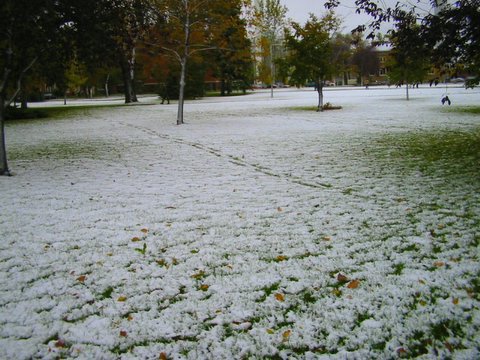
It is that time of the year, when it has snowed and the snow has not gone away. At this point you know that the snow is here for the next six months. Also with daytime saving kicking in (whatever is the logic behind this concept), and when it starts getting dark at 5 PM, the depressing cycle of the year has just begun.
Neways this is a thing which happens only at the begining and the end of winters. During these times, when the temperature swings across the freezing point; the SNOW melts when the temperature goes positive, and when the temperature comes back in the negative, the melted snow freezes back to form ICE. This ICE causes people to slip and skid all the time.
Note, the differnce between these two words, ICE and SNOW. Snow is soft and crystalline, when you put your foot in a pile of snow, it goes right in. On the other hand there does not even exist nething called a pile of ice. Ice is amorphous and slippery.
What prompted me to write this post was that, the two words 'ICE' & 'SNOW' dont even exist in Marathi OR Hindi. There is only one word for it 'barfa' , 'baraf'.
Do these words really dont exist, or I am just not aware of them? Or is it possible that they do exist in Kashmiri perhaps?
Thursday, October 12, 2006
Wednesday, October 11, 2006
Destiny....
Everyone today acknowledges Amitabh to be the biggest and greatest flim star in India ever. But little do we know that there is a lot of fate involved in making of this star. A lot of permutations are involved in any one's success.
You can read here, about his initial few years in bollywood. Apparently, after his long line of initial flops he had planned to return to Allahabad if his movie Zanjeer hadn't worked. When in the beginning the movie didn't do well, he went down with a fever, but after the first week when it started doing very well, his fever became even worse, as he couldn't believe that he was finally a superstar.
Also I didn't know the fact that he was at a certain time known as a tall idiot actor!!! Truly amazing.
You can read here, about his initial few years in bollywood. Apparently, after his long line of initial flops he had planned to return to Allahabad if his movie Zanjeer hadn't worked. When in the beginning the movie didn't do well, he went down with a fever, but after the first week when it started doing very well, his fever became even worse, as he couldn't believe that he was finally a superstar.
Also I didn't know the fact that he was at a certain time known as a tall idiot actor!!! Truly amazing.
Saturday, October 07, 2006
China will be ready. Will India be?
Here is an interesting article, I came across. While this only gives the story from just one side, I hope our foreign policy and defense strategists are aware of the possible machinations.
Friday, September 15, 2006
Vande Mataram
India's national identity is drawn from its culture and symbols of nationhood cannot be completely devoid of cultural overtones.
Quoting from a recent article by Sudheerendra Kulkarni in I.E.; "As for the Leftists’ claim that the “the national ethos” of post-1947 India should be “only civic and territorial in nature”, and that it must have no cultural underpinnings and overtones — because that would make cultural nationalism as the basis of India’s nationhood — its sheer inanity is mind-boggling. By this logic, our Motherland would be reduced to a mere civic entity, cleansed of all its rich cultural-spiritual ecology, and the Republic of India, with its proud legacy of a living civilization that is over 5,000 years old, will have to be replaced by the Municipal Corporation of India."
In the following articles he also with rational arguments explains why singing Vande Mataram shouldn't be a problem to anyone by giving an analogy of Naguib Mahfouz in Egypt, and citing Nehru. There is no need for a disclaimer, if u read the linking articles.
I hope the readers are mature enough to not misinterpret the context.
Part 1. Part 2.
Quoting from a recent article by Sudheerendra Kulkarni in I.E.; "As for the Leftists’ claim that the “the national ethos” of post-1947 India should be “only civic and territorial in nature”, and that it must have no cultural underpinnings and overtones — because that would make cultural nationalism as the basis of India’s nationhood — its sheer inanity is mind-boggling. By this logic, our Motherland would be reduced to a mere civic entity, cleansed of all its rich cultural-spiritual ecology, and the Republic of India, with its proud legacy of a living civilization that is over 5,000 years old, will have to be replaced by the Municipal Corporation of India."
In the following articles he also with rational arguments explains why singing Vande Mataram shouldn't be a problem to anyone by giving an analogy of Naguib Mahfouz in Egypt, and citing Nehru. There is no need for a disclaimer, if u read the linking articles.
I hope the readers are mature enough to not misinterpret the context.
Part 1. Part 2.
Friday, August 25, 2006
Andaz Apna Apna
One of the most poular movies in Hindi Cinema has been Andaz Apna Apna. But after watching Dumb And Dumber, I realised that it might have a lot of scenes ripped off from D&D. Like the one in which after Aamir Khan adds some stuff to Salman's food, and then he has to keep visiting the restroom. D&D has the exact same scene.
But a little bit of googling tells me that D&D released on 16th Dec 1994, whereas AAA also released in 1994 (dont know the exact dates) but also that it took five years to make the film, because Aamir and salman didnt get along too well. This probably implies that D&D got the inspiration for the scene from AAA! If they indeed did, I don't know how that was possible because of the short time span between the two releases.
But a little bit of googling tells me that D&D released on 16th Dec 1994, whereas AAA also released in 1994 (dont know the exact dates) but also that it took five years to make the film, because Aamir and salman didnt get along too well. This probably implies that D&D got the inspiration for the scene from AAA! If they indeed did, I don't know how that was possible because of the short time span between the two releases.
Wednesday, August 02, 2006
Outsourcing- Beat this!
While having a conversation with Chris and Adam one friday afternoon about everything from the UN, world economies to US and outsourcing, I distinctly remember Chris saying, "Can we just outsource the war in Iraq to India?"
Looks like it is pretty much happening. You can read it here. Also the big question is What Next?
Looks like it is pretty much happening. You can read it here. Also the big question is What Next?
Tuesday, August 01, 2006
Mogambo khush hua !
I came across this article in the Mid Day. Being an admirer of Amrish Puri, I was surprised to come across facts about him which I did not know earlier. His interaction with Spielberg and also the fact that Sanjay Dutt is his nephew was interesting.
Tuesday, July 18, 2006
Power of Blogging
 In the wake of the recent attacks in Mumbai, the Indian government has blocked ExposingTheLeft .Blogspot.Com. Not going in the nitty gritty of this issue (regarding the ethicalness of it), one thing is clear that bloggers have power which can upset governments.
 With the flow information and news lucified by the internet, every individual in the world has access to pretty much all that is to know about the happenings around the globe first hand. Hence no longer can governments and the tradional media fool and misguide masses.
Recently a lot of the people are of the opinion that NDTV and CNN-IBN are biased. Although NDTV has a very capitalistic outlook, they are extremely soft when it comes to reporting on the Left front. Wanna know why? Perhaps not many people are aware that Pronoy Roy’s wife Radhika Roy (she calls the shots in the organization along with Mr. Roy) is sister of Brinda Karat, a senior leader of CPI-M and wife of CPI-M General Secretary Prakash Karat.
A few years back when the NDA government was in power, Murli Manohar Joshi (who is considered to be BJPs Arjun Singh equivalent), had introduced a change in the fee structure in the IIMs. NDTV had very harsh criticism lined up for him, when not a single soul was protesting on the streets. Recently when the whole of India was outraged about Arjun Singh's policies, surprisingly NDTV didn’t find much too wrong with, if you compare it with the former. Radhika Roy is allegedly close to the Caucasian female.
CNN-IBNs Rajdeep Sardesai has also very serious allegations about being biased.
In a nut shell, what I mean is, people can always read newspapers and listen to news on the television, but they can now also access the situation first hand and come to their own conclusion, and also publicize it (through blogs). Hence they have a new found power which if used ethically can serve for the betterment of the society, and not just believe what the traditional media have to say.
Friday, July 07, 2006
Pope scared of hawking?
According to this article, Pope John Paul 2, asked scientists at a conference not to study too much about the beginning of the universe since it was the work of God. Probably he might have been gravely concerned about science exposing the theist fallacy.
I really wonder if the religious leaders do know that they are misguiding the common folks. Their whole life is concerned with God, I am sure the rational ones on questioning themselves must have realized how wrong every one is about god. If each one of us had never been told of the concept of God, we would have never imagined it on our own.
But we are so used to this, having been told about this since birth, that we have never questioned this belief, which really amazes me.
Also Stephen hawking is quoted in the article saying, "We are getting closer to answering the age-old questions: Why are we here? Where did we come from?"
How close are we?
This is a question that even Mr. Hawking may not be able to answer. But I hope to know it in my lifetime.
Probably God can answer it. What an irony !
I really wonder if the religious leaders do know that they are misguiding the common folks. Their whole life is concerned with God, I am sure the rational ones on questioning themselves must have realized how wrong every one is about god. If each one of us had never been told of the concept of God, we would have never imagined it on our own.
But we are so used to this, having been told about this since birth, that we have never questioned this belief, which really amazes me.
Also Stephen hawking is quoted in the article saying, "We are getting closer to answering the age-old questions: Why are we here? Where did we come from?"
How close are we?
This is a question that even Mr. Hawking may not be able to answer. But I hope to know it in my lifetime.
Probably God can answer it. What an irony !
Thursday, June 22, 2006
Questions by a fellow atheist
How do you justify your existence?
I am wondering how many of you out there wonder about your existence? What on earth are you doing here?
I always get amazed when I think about the complexity of the life forms....for instance...all complex life forms have almost perfect design for seeing things around - eyes? similarly for hearing?...for that matter any part of the body......and humans have outclassed other species with...complex network of neurons...which helps them to think ahead in future!!
And more amazing is the fact that all these evolution occured begining with random aggregation of molecules to start with and..life kicked itself into action....the aggregation that survived the hostile environment..what Darwin would say....'survival of fittest'....replicated further....and aggregated further...and continue to evolve.....over millions of years....to what we are today.....and so it continues....the battle of survival...which including humans inherently indulge in every day...as proved by the way humans would try to outclass/compete other peers, find a better mate, etc....
It appears all life forms are survival machines designed to take advantange of different environment/living conditions to do one thing best....survive!....ensure the propagation of their design....which is embedded in the genes!!
So what are we, biological survival machines - biological robots ??
[courtesy: ORKUT]
WHAT I HAVE TO SAY ABOUT IT.
I have thought about it, and continue to think about it, futilely though, this is the biggest reason why humans thought of the concept of god in the past, currently people are too ignorant to question themselves. probably some day scientists will answer the question. hopefully in my lifetime.
I am wondering how many of you out there wonder about your existence? What on earth are you doing here?
I always get amazed when I think about the complexity of the life forms....for instance...all complex life forms have almost perfect design for seeing things around - eyes? similarly for hearing?...for that matter any part of the body......and humans have outclassed other species with...complex network of neurons...which helps them to think ahead in future!!
And more amazing is the fact that all these evolution occured begining with random aggregation of molecules to start with and..life kicked itself into action....the aggregation that survived the hostile environment..what Darwin would say....'survival of fittest'....replicated further....and aggregated further...and continue to evolve.....over millions of years....to what we are today.....and so it continues....the battle of survival...which including humans inherently indulge in every day...as proved by the way humans would try to outclass/compete other peers, find a better mate, etc....
It appears all life forms are survival machines designed to take advantange of different environment/living conditions to do one thing best....survive!....ensure the propagation of their design....which is embedded in the genes!!
So what are we, biological survival machines - biological robots ??
[courtesy: ORKUT]
WHAT I HAVE TO SAY ABOUT IT.
I have thought about it, and continue to think about it, futilely though, this is the biggest reason why humans thought of the concept of god in the past, currently people are too ignorant to question themselves. probably some day scientists will answer the question. hopefully in my lifetime.
Wednesday, June 21, 2006
Yet another Rahul in the news
As if news created by Rahul Mahajan was not enough, Rahul Bajaj decided to jump in the scribes too. Ironically his being in the news has a lot to do with Pramod 'so many skeletons in the closet' Mahajan. The rajya sabha seat vacancy caused by the soap opera like episode, had to be filled, to which Rahul Bajaj was nominated by NCP, and backed by BJP-Shiv Sena. The congress had fielded its own candidate for it.
This caused so much tension between the NCP and the Congress that there were rumors of NCP allying with BJP.
So Bajaj's nomination for the Rajya Sabha post almost split the NCP and the Congress. This is so very ironic. Ironic because the Bajajs over last few generations have known to be congress loyalists. Jamanalal Bajaj was follower of Gandhi, and was sort of adopted by him. He was also very active member of Indian national Congress then. Rahul Bajajs father was treasurer of the Congress party after 47. However Rahul Bajaj is not exactly following their foot steps. In the Walk the Talk interview, he was queried by Shekhar Gupta, if he is more inclined towards the BJP.
Well if the Congress and NCP do split, and the NCP allies with BJP, the Shiv Sena will surely split with the BJP (as they threatened to do in the last lok sabha elections, when there were speculations of Sharad Pawar allying up with BJP). Congress and Shiv Sena can never be allies and Raj Thackeray will never ally with Shiv Sena. Raj Thackeray allying with Congress also does not seem possible. So a Raj/BJP/NCP can indeed be a winning combination.
A lot of Iffs and Buts, but will surely be interesting in the next elections.
This caused so much tension between the NCP and the Congress that there were rumors of NCP allying with BJP.
So Bajaj's nomination for the Rajya Sabha post almost split the NCP and the Congress. This is so very ironic. Ironic because the Bajajs over last few generations have known to be congress loyalists. Jamanalal Bajaj was follower of Gandhi, and was sort of adopted by him. He was also very active member of Indian national Congress then. Rahul Bajajs father was treasurer of the Congress party after 47. However Rahul Bajaj is not exactly following their foot steps. In the Walk the Talk interview, he was queried by Shekhar Gupta, if he is more inclined towards the BJP.
Well if the Congress and NCP do split, and the NCP allies with BJP, the Shiv Sena will surely split with the BJP (as they threatened to do in the last lok sabha elections, when there were speculations of Sharad Pawar allying up with BJP). Congress and Shiv Sena can never be allies and Raj Thackeray will never ally with Shiv Sena. Raj Thackeray allying with Congress also does not seem possible. So a Raj/BJP/NCP can indeed be a winning combination.
A lot of Iffs and Buts, but will surely be interesting in the next elections.


 Posts
Posts


